- About
- Academic Programs
- Application for Physics Ph.D. and M.S. degrees
- Doctoral Program
- Masters Degree in Physics
- Masters in Physics Entrepreneurship
- Master of Science in Physics, Medical Physics Track
- Medical Physics Certification for PhDs and PhD Students
- Graduate Course Descriptions
- Graduate Course Syllabi
- Physics Graduate Student Association
- Research
- Seminars & Colloquia
- News & Videos
- Local
- Support Us

Tom Crawford (U. Chicago)
Date: Tue. April 21st, 2026, 11:30 am-12:30 pmLocation: Foldy Room
New Cosmological Results from the South Pole Telescope
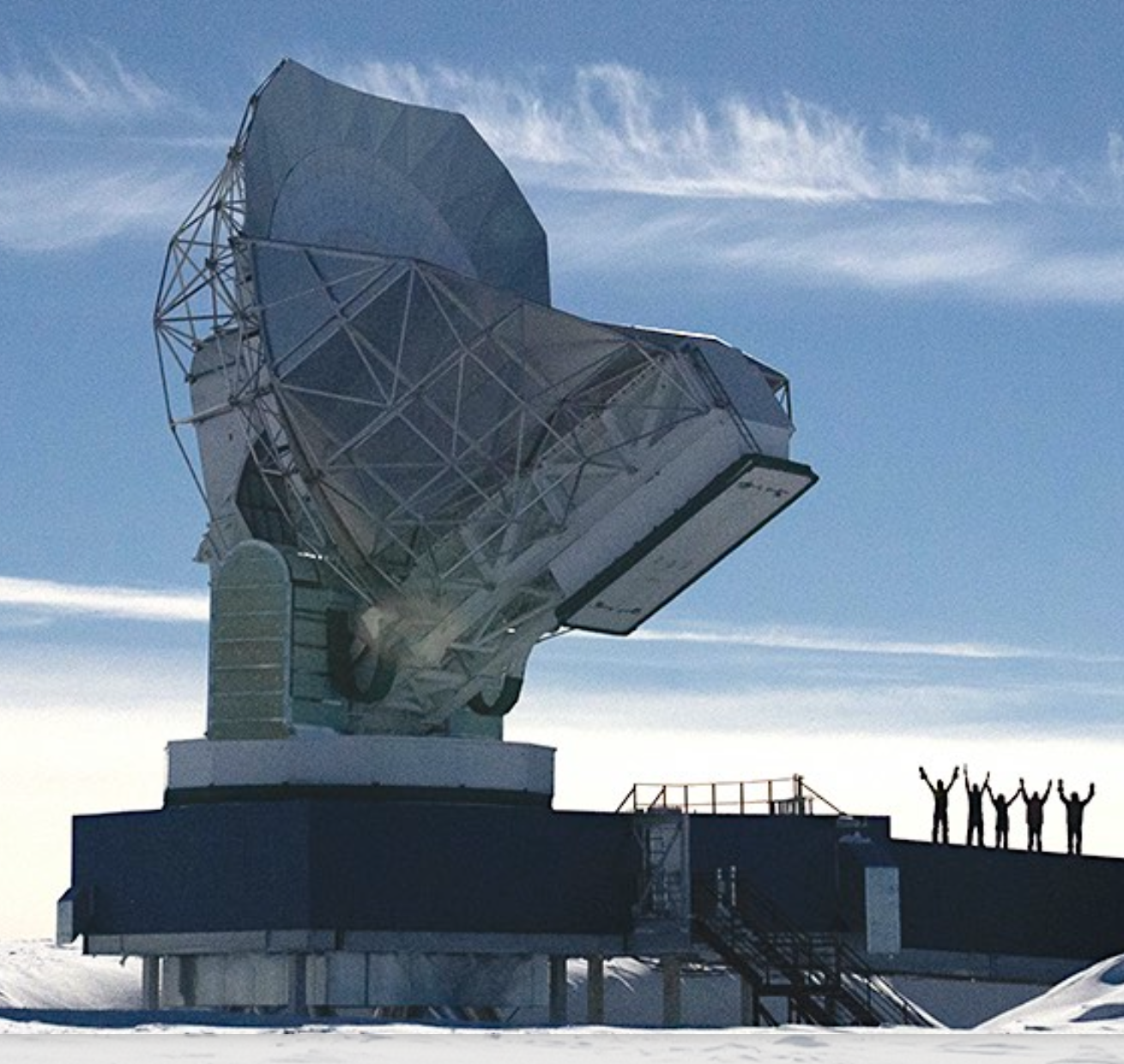 The South Pole Telescope (SPT) is a 10-meter-diameter millimeter/submillimeter (mm/submm) telescope located at the National Science Foundation Amundsen-Scott South Pole Station, one of the best sites on Earth for mm/submm observations. The SPT is currently equipped with the SPT-3G camera, the most sensitive CMB camera in active operation. In this talk I will discuss recent results, and preview upcoming results, from SPT-3G data taken in 2019-2020. Highlighting the recent release are new measurements of the temperature and E-mode polarization power spectra (and their cross spectrum, i.e., TT, TE, and EE) that are the most sensitive ever at small scales (high multipole number). When paired with CMB lensing estimates from the same data, obtained with a new beyond-quadratic-estimator algorithm, these enable constraints on cosmological parameters that are competitive with the final Planck constraints. When combined with other ground-based CMB measurements (in particular those from the Atacama Cosmology Telescope), these constraints surpass the power of Planck in some key parameters, representing a milestone for ground-based CMB. The aforementioned results all come from deep observations of a 1500-square-degree field; I will also discuss the Extended-10k survey totaling 10,000 square degrees, which will improve cosmological constraints by another factor of ~50 (in total LCDM parameter volume) and serve as a pathfinder for upcoming deep-and-wide CMB surveys such as Simons Observatory. I will also briefly discuss plans for the next camera on the SPT.